

Does AI Can Potentially Solve World Hunger?
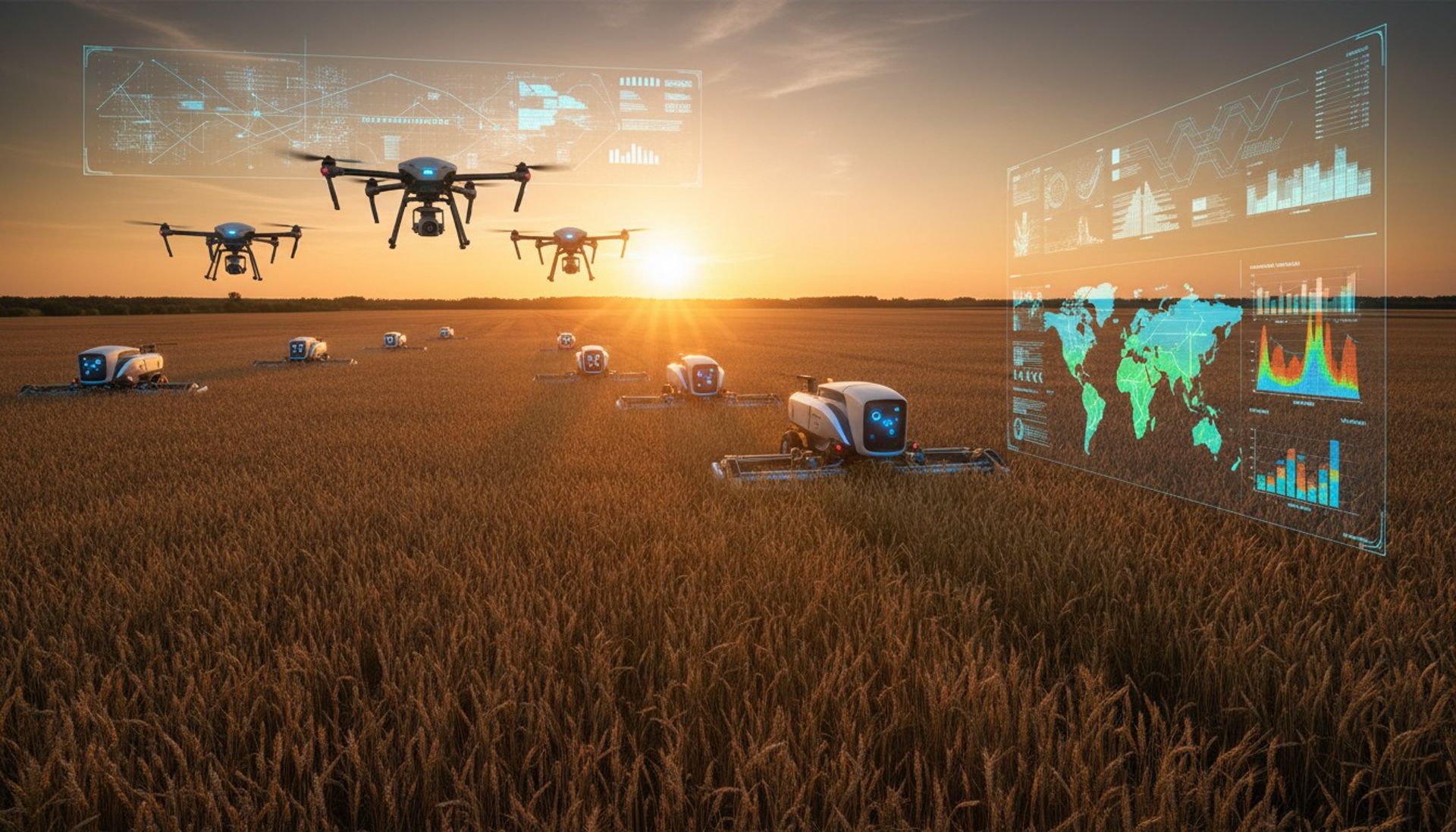
Imagine the world where we can predict everything in advance! Indeed, the first thought is, it would be a fascinating world!. But if you think again for a moment, it is a boring world with no excitement of unknowns!
From the beginnings, people predicted things about future based on their five senses (Touch, Sight, Hearing, Smell and Taste). Future is relative in terms of time. Predicting rain for afternoon based on seeing clouds in the sky was perhaps something humans learned from the beginning. The race has been always about how much into the future one can predict, and fortune tellers make a living based on predictions and is still a well-practiced profession!
So analytics has a long history of existence in different forms and practice. While computing and digitally capturing data occurred later in history, we could easily assume that human brains were doing analytics and decision making in everyday living throughout the history of mankind.
But we can all certainly agree the analytics is a phenomenon at scale today, which is applied in every aspect of life and business with the ability to digitize data and democratization of computing.
Every business today is focused in analytics. Almost all decision making is driven by some underlying analytics. Leading organizations has democratized data access and analytics, so individuals can make decisions and hypothesis based on data rather than just human intuitions. Predictive analytics based on regressions and classifications has been in industry for a long time as well.
With the democratization of computing (cloud & edge), storage, connectivity and sensors coupled with the accessibility to Artificial Intelligence, machine learning, deep learning, a new world of possibilities has opened for every industry and domain. But the success of these is highly dependent on curated data at scale. Machine learning and Deep Learning is great if we have enough curated training set for the problem we are trying to solve. Deep learning needs continues supply of these curated data to enhance the model performance on continues basis.
Almost all organizations(leaders) are always on the forefront of hype without understanding the reality!. We all live in a world where, every day we are bombarded with communications about the potential of Artificial Intelligence. Unfortunately, without curated data at scale, predictive analytics is as good as asking the fortune teller!!
Think about the amount of images a deep learning model needs to identify between a cat and dog! Think about how much voice input is needed to transcribe!. Think about the millions of miles of driving for realizing autonomous vehicles! With Artificial Intelligence, as it exists today with democratized computing and memory with Deep Learning, there are indeed plenty of use cases, it is exponentially more powerful compared to humans.
Simply Put, no Artificial Intelligence as we know today is as good as human brain in training and learning visual patterns within visible frame of human eyes. But any patterns which involve computing for learning, machines and models (Artificial Intelligence) is exponentially better and faster than humans. Reality is simply, machines are not yet able to process five senses (Touch, Sight, Hearing, Smell and Taste) like humans.
How one should determine viability of use cases as a good fit for Artificial Intelligence /Machine Learning /Deep Learning ?
- Do you have curated, sustainable data in the domain where the use case exists? If the answer is no and you have to get people to clean data manually all times, please understand the AI can only give you directional answers without certainty!
- If the use case is just making decisions based on visual patterns and there are enough images to train models continuously and need high throughput in decision making compared to humans, it is a good candidate. (eg: Machine vision applications with robotics is a great example)
- If you have mass volume of continues data, that is being generated by machines, sensors etc., this is true gold mine for machine learning. This is a use case where you should be able to realize the true potential of Artificial Intelligence with confidence.
Comments
Related Posts
 Article
The Continued Experiments of Humanity
As the United States approaches its 250th anniversary, it is worth pausing to reflect on a broader reality: humanity has been running parallel experiments in governance for over a century.
 Article
The Anatomy of Corporate Culture: How to Build and Sustain What Truly Matters
Corporate culture is often heralded as the backbone of organizational success, yet it remains an elusive concept for many leaders. It is more than ping-pong tables and free lunches.
 Article
Change Management - The Most Prominent Member of the Corporate Vocabulary Landfill
For far too long, change management has been the go-to buzzword in corporate corridors. It is a shimmering smokescreen that obscures the real challenge: the hard work of actually changing.